
Most people assume moving from Abu Dhabi to Dubai is just the same trip in reverse, but the paperwork and property rules don’t treat it that way. In Abu Dhabi, building management usually wants advance notice tied to a tenant record, and some won’t even look at a move request unless the clearance comes through their own portal or supervisor chain. Once the truck reaches Dubai, the rules flip. Security teams often want plate numbers logged ahead of time, and some towers won’t open the loading bay unless the move has been pre-registered with the facility operator or community app.
Even the timing rhythm is different. Abu Dhabi properties tend to push moves toward late morning once building staff are in place, while Dubai buildings often force crews to start early or wait until evening slots. When the timing at the departure point doesn’t match the access window at the destination, the truck reaches the gate too soon or too late—and that’s when security decides whether to let it in or send it to wait around the block (Abu Dhabi Municipality – Tenant Move-Out Procedures; Dubai Community Facility Access Guidelines).
2. Two Cities, Two Very Different Approval Games
Getting a move cleared on both ends sounds simple until you see how differently Abu Dhabi and Dubai handle paperwork. In Abu Dhabi, most buildings want the tenant or company to request the move-out notice through the management office or a municipality-linked portal. Some won’t release the NOC unless service charges or tenancy documents are fully updated. If the approval isn’t stamped or logged correctly, the guard at the loading area can stop the crew before they touch a single box.
Dubai doesn’t follow the same script. Many towers and gated communities expect the move-in or delivery details to be filed with security or the facilities operator well in advance. Some require QR codes, plate registrations, or a confirmation slip that the building team checks before opening the service lift. If anything is missing, they’ll claim the slot is closed—even if the truck is parked outside.

3. The Silent Time-Killer: Parking Bays and Service Lifts
Moves don’t usually stall on E11; they stall ten metres from the lobby. A guard points to a sign, the lift is “booked by someone else,” or the loading bay isn’t on the schedule. By the time a fresh slot appears, the truck has missed its clean exit window and the day starts slipping. The fix is boring but powerful: reserve the bay and the service lift on both ends before a single box is taped, and carry something a supervisor can stamp without making calls (Dubai Municipality).
What actually prevents the downstairs bottleneck:
- Book the service elevator in writing, not by phone. Most managed properties want a dated reservation tied to a unit number and time range; walk-ups get bumped when a scheduled team arrives (TAMM).
- Lock a loading-bay slot that matches truck size. Towers often separate van bays from heavy vehicles; the wrong slot means refusal or a redirect to street parking.
- Carry a building NOC / move-in or move-out confirmation for each side. One document per property—origin and destination—because approvals aren’t transferable across emirates or managers.
- Have plate numbers pre-registered with the destination security. Many Dubai sites log plates against a booking; if it’s not in the system, the barrier stays down.
- Bring a paper trail the guard can stamp. Printed permit, company CR, Emirates IDs, and the supervisor’s contact; paper clears faster than screenshots when Wi-Fi drops in basements.
- Align lift time with crew shifts. If the lift window starts before the team is on site, you lose the slot and the next one may be hours away.
Why these sources matter: Abu Dhabi routes most housing permissions through TAMM / Department of Municipalities & Transport workflows, while Dubai Municipality provides NOC services and the compliance framework that community and building managers enforce on the ground. Those two touchpoints decide whether the basement opens—or you circle the block.
4. Documents That Keep the Truck From Getting Stuck
Most delays don’t come from the road—someone gets stopped at a gate, a lift lobby, or a service entrance because a single sheet of paper isn’t ready. The crews that move straight through aren’t lucky; they just carry the right mix of paperwork before anyone asks for it. Here’s what actually prevents phone calls, security arguments, and last-minute detours (Abu Dhabi Municipal Service Portals; Dubai Building Access & Facility Management Coordination Rules):
- Move-out approval from the Abu Dhabi building: printed, stamped, and tied to the tenant or unit so the guard doesn’t call upstairs.
- Move-in confirmation from the Dubai side: some sites want it from facilities, others from community management, but all expect it before a truck rolls in.
- Vehicle plate registration or gate pass: a lot of Dubai properties enter this into their system ahead of time; if it’s missing, the truck waits outside.
- Driver ID and company trade license copy: inspectors and guards ask for one or both, especially in gated communities and mixed-use towers.
- Delivery or relocation letter with contact details: makes it easy for security to verify without stalling the crew.
- Loading bay or elevator booking slip: even if verbally “approved,” most buildings want a document they can show a supervisor.
- Backup printouts of digital permits: screenshots slow things down when Wi-Fi drops in basement areas.)
5. Fleet Size vs Hours Lost (or Gained)
Most people think the number of trucks only affects cost, but it quietly controls timing, access, and how long a crew stays stuck between two buildings. Send too few vehicles and the team ends up making repeat trips. Send too many and security turns half of them away for blocking bays or entering without clearance. The right fleet size isn’t about volume—it’s about matching building rules, slot availability, and elevator timing (Regional Transport Coordination Notes).
Here’s how fleet choices impact the clock:
| Fleet Setup | What Usually Happens | Time Outcome | Where It Goes Wrong |
| One large truck | Fewer trips but harder to park or clear at both sites | Often slower overall | Loading bays and lift access don’t match vehicle size |
| Two mid-size trucks | Split loads and parallel unloading | Saves 1–2 hours | Requires both bays to be booked in advance |
| Three small vehicles | Easier entry and faster clearance at security points | Saves time only if coordinated | Multiple permits needed, more plate registrations |
| Single trip strategy | Convenient on paper but risky if access is delayed | Adds hours if the slot is missed | One delay affects the entire move |
| Split-load approach | Crew divides items across vehicles and timings | Gains flexibility | Requires double coordination with both buildings |
| Oversized fleet | Looks efficient but causes gate refusals or stacking delays | Time loss at checkpoints | Guards block excess vehicles not listed in approval |
6. The Lift, Not the Highway, Decides Your Finish Time
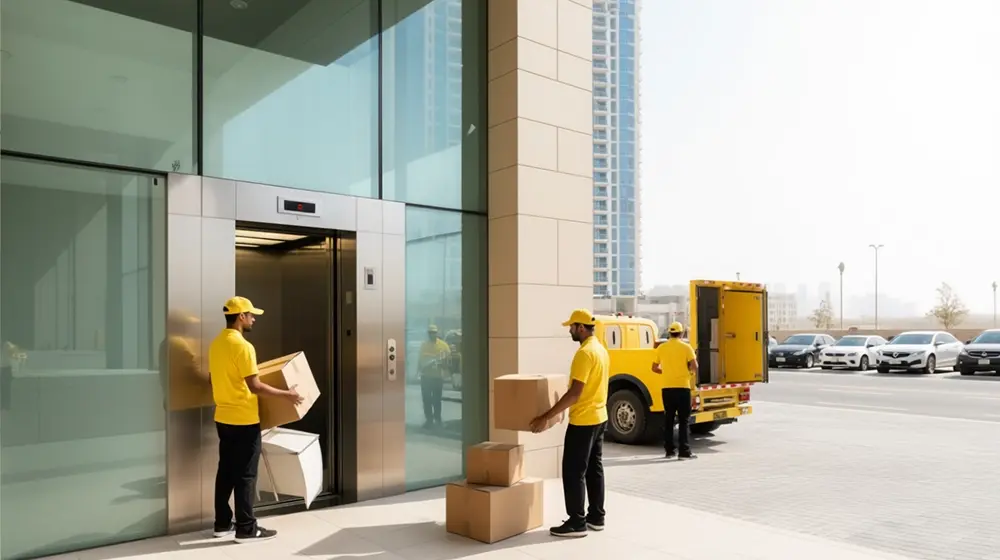
Most clients assume the real delay happens somewhere on Sheikh Zayed Road, but the slowdown usually begins the moment the truck reaches the building. If the service lift isn’t available at the exact time the crew arrives, everything goes on hold—boxes sit on the sidewalk, furniture stays in the truck, and the access slot at the other end starts slipping.
Abu Dhabi buildings often stack multiple move-outs in the late morning, which means crews sometimes wait behind another team even if they showed up early. In Dubai, it’s common for building management to block lift use during peak resident hours or prayer breaks, and some towers shut the service elevator entirely during lunchtime. Once a slot is missed, the next window may be hours later—and by then, the return truck timing or unloading access at the destination is out of sync (Dubai Facility Access Scheduling Rules; Abu Dhabi Building Operations and Tenant Move Coordination Notes).
Most movers don’t lose time driving between cities. They lose it outside the lift door while a guard tells them to wait for “clearance from the office upstairs.”
7. Who Slows You Down More? NOC Delays by Property Type
Not all buildings process approvals the same way, and that’s where timing gets wrecked. Some managers issue confirmations in a few hours, while others take days and want calls, forms, or deposits before signing anything. When a move spans two emirates, the slowest property sets the pace—no matter how ready the crew or trucks are (Municipality Approval Channels).
Here’s how different property types stack up when it comes to clearance speed:
| Property Type | Abu Dhabi NOC Turnaround | Dubai Move-In / Move-Out Timing | Where Delays Usually Start |
| Residential Towers | 24–72 hours, often via portal or manager approval | Same-day possible, but many need pre-booked slots | Missing tenancy link or pending service charges |
| Villas / Townhouses | Faster if owner-managed, slower with gated communities | Often requires guardhouse notice and security clearance | Access codes and ID checks at community entry |
| Office Buildings | Requires company documents and tenancy validation | Booking tied to loading bay and lift schedule | Facility teams request stamped letters |
| Mixed-Use Properties | Depends on management chain—some use TAMM or in-house forms | Often tied to community app or landlord representative | Confusion over which department signs off |
| Serviced Apartments | Usually strict on documentation and deposits | Move-in windows enforced tightly | Reception checks every vehicle and crew member |
8. Fleet Size Isn’t About Space:It’s About Access
A lot of people think the number of trucks is just a question of how much stuff needs to be moved, but the real limit is how many vehicles a building will actually let in. Some Abu Dhabi properties only clear one vehicle per move-out letter, even if the apartment is large. On the Dubai side, certain towers will only register the exact vehicle plate submitted in advance—anything extra gets turned away or sent to wait off-site.
What really causes time loss isn’t the drive between emirates—it’s the mismatch between manpower, permits, and parking slots. One truck can overload a loading bay and block access to other tenants, while three smaller vehicles might clear security faster but require separate paperwork for each plate. If the fleet isn’t planned around the building rules, crews end up stuck outside with furniture still in the vehicle and a lift slot slowly expiring upstairs.
Seasoned movers don’t just count cubic meters—they count how many bays they’re allowed to occupy, how many elevators are tied to the booking, and how many drivers can get through a gate without being stopped.
9. The Smartest Crews Clear Dubai Before They Pack in Abu Dhabi
People assume step one is packing, but experienced movers don’t start there. They first make sure Dubai has confirmed the move-in access—service lift, loading bay, plate numbers, and timing. Only after the destination signs off do they begin packing in Abu Dhabi. The reason is simple: if the receiving building blocks the truck on arrival, the entire operation stalls with a full load and no legal place to unload.
Many delays happen because someone thought “we’ll sort it out once the truck is on the way.” That works for local moves, not inter-emirate transfers. Once the vehicle crosses into Dubai without a pre-logged entry or vehicle ID, security can—and often does—deny immediate access. That forces the truck to wait on the street or detour to a holding area while the crew calls three different departments looking for approval.
The teams that avoid this mess do something most clients never see: they treat the destination as the starting point, not the end of the move (Dubai Property Access Pre-Registration Practices).
10. Final Take:The Delays Don’t Start on the Road
Most people blame traffic, checkpoints, or toll systems when a move runs late—but the issues begin long before the ignition turns. If the NOC on the Abu Dhabi side isn’t cleared early enough, the crew can’t load on time. If the Dubai property doesn’t lock in a lift slot or won’t register the truck plate in advance, arrival turns into waiting outside the gate. Fleet size, elevator timing, loading bay reservations, and permit formats decide how smoothly the day goes—none of it has anything to do with the highway.
The move only looks like a transport job from the outside. In reality, every hour gained or lost comes down to building rules, paperwork windows, and how well the fleet plan fits the access limits on both ends. Crews that finish early aren’t faster—they’re just not stuck fixing avoidable problems after the truck leaves the first curb.