`
Every hour of downtime costs UAE businesses thousands of dirhams in lost productivity, missed opportunities, and disrupted client relationships. For enterprises operating around the clock in Dubai’s competitive commercial landscape, traditional office relocation approaches that shut down operations for days or weeks are simply not viable. The challenge becomes clear: how do you physically move an entire office while maintaining seamless business continuity?
The answer lies in strategic phased relocation, a sophisticated approach that professional office movers and packers have refined specifically for the UAE’s demanding 24/7 business environment. This methodology transforms what was once a disruptive ordeal into a carefully orchestrated transition that keeps your revenue flowing, your team productive, and your clients satisfied throughout the entire moving process.
Key Takeaways
- Phased office relocation enables continuous business operations during moves, eliminating costly downtime for UAE enterprises operating 24/7 schedules.
- Strategic sequencing of IT infrastructure, workstations, and support facilities across multiple phases minimizes disruption while maintaining client service standards.
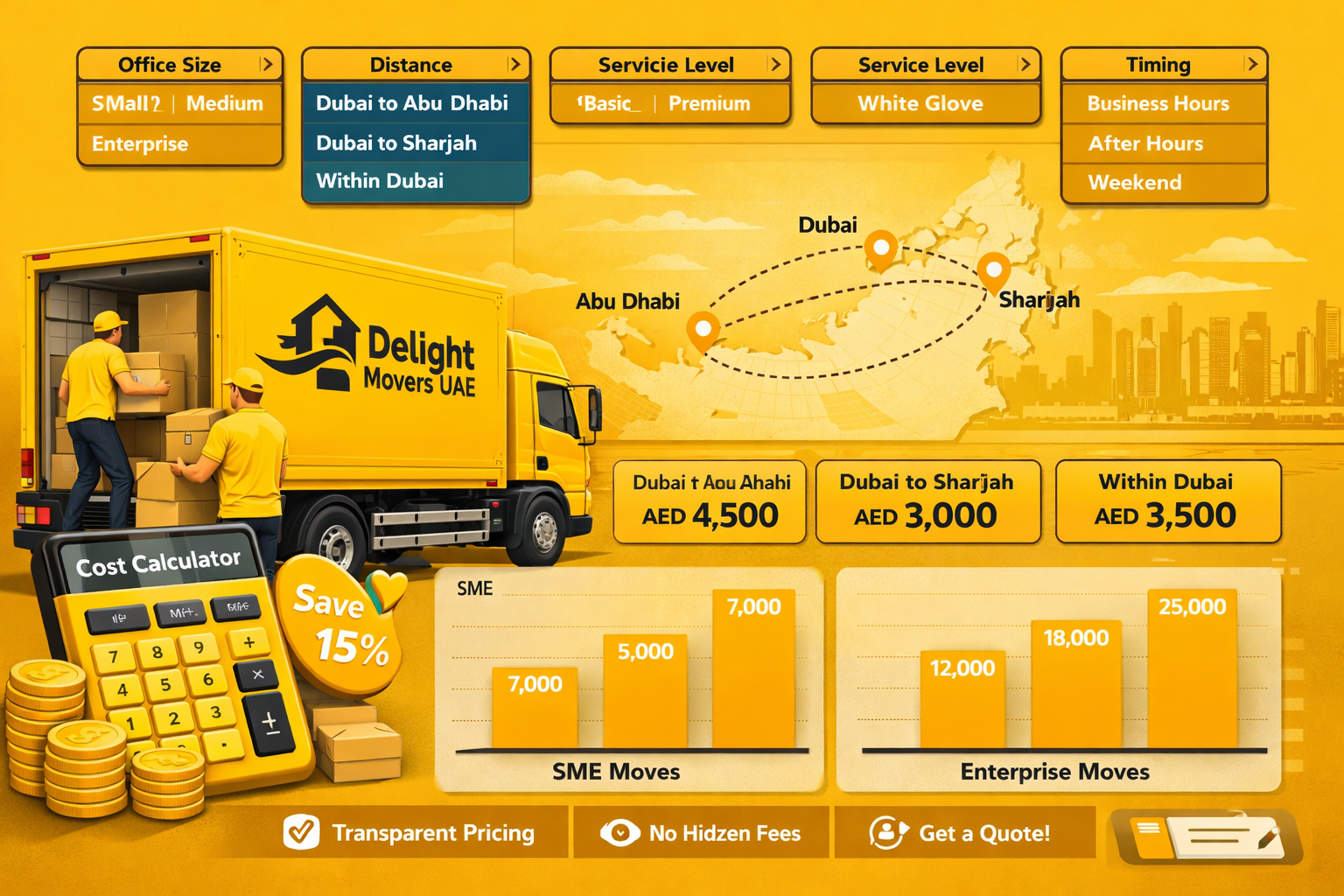
- Professional office movers cost for zero-downtime projects ranges from AED 7,000 to AED 25,000 depending on office size, complexity, and timing requirements.
- Route planning, building access coordination, and regulatory compliance across Dubai, Abu Dhabi, and other Emirates require specialized expertise from experienced movers and packers.
- Technology-enabled tracking, detailed inventory management, and dedicated project coordination ensure accountability throughout multi-phase relocations.
Understanding Zero-Downtime Office Relocation in the UAE Context
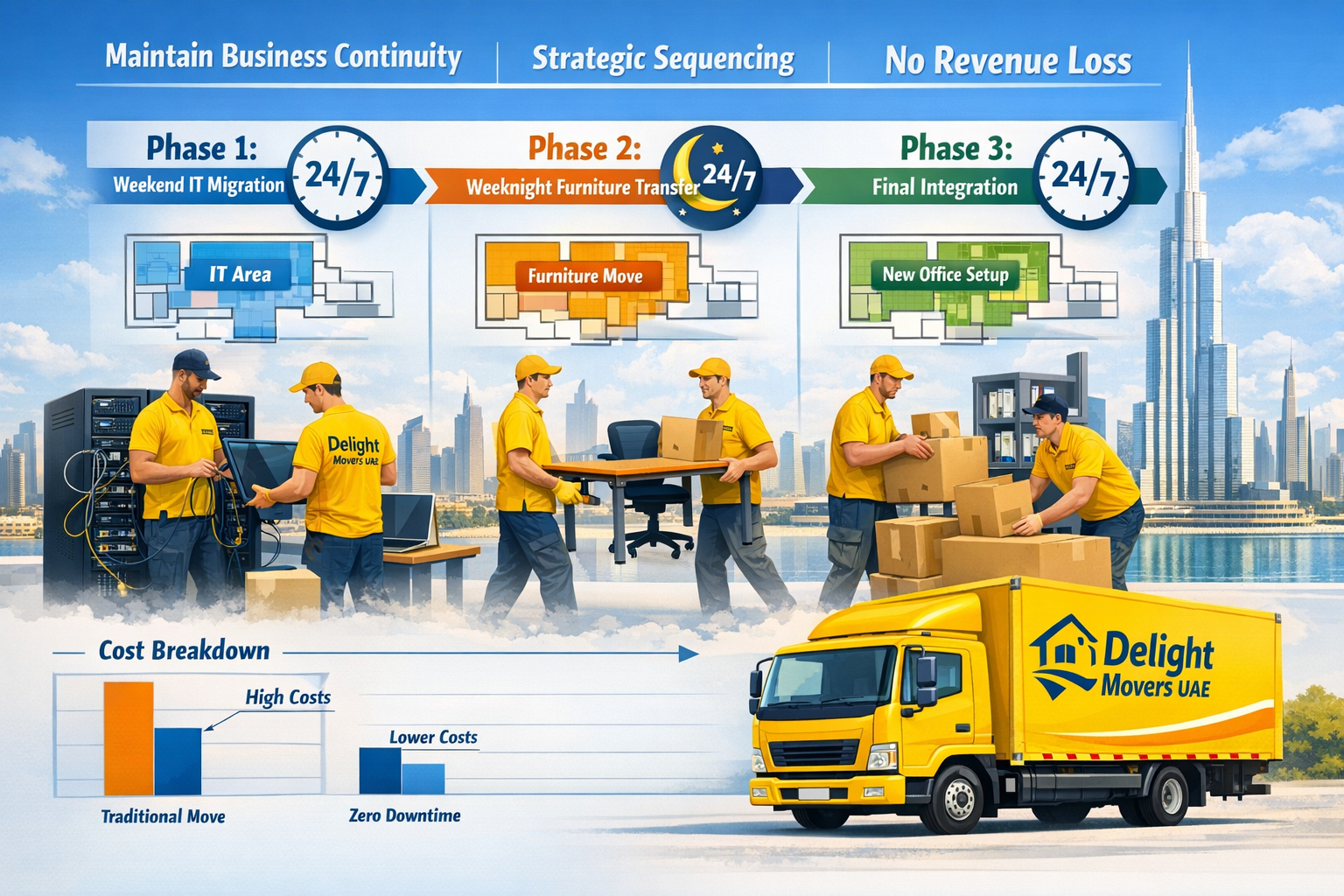
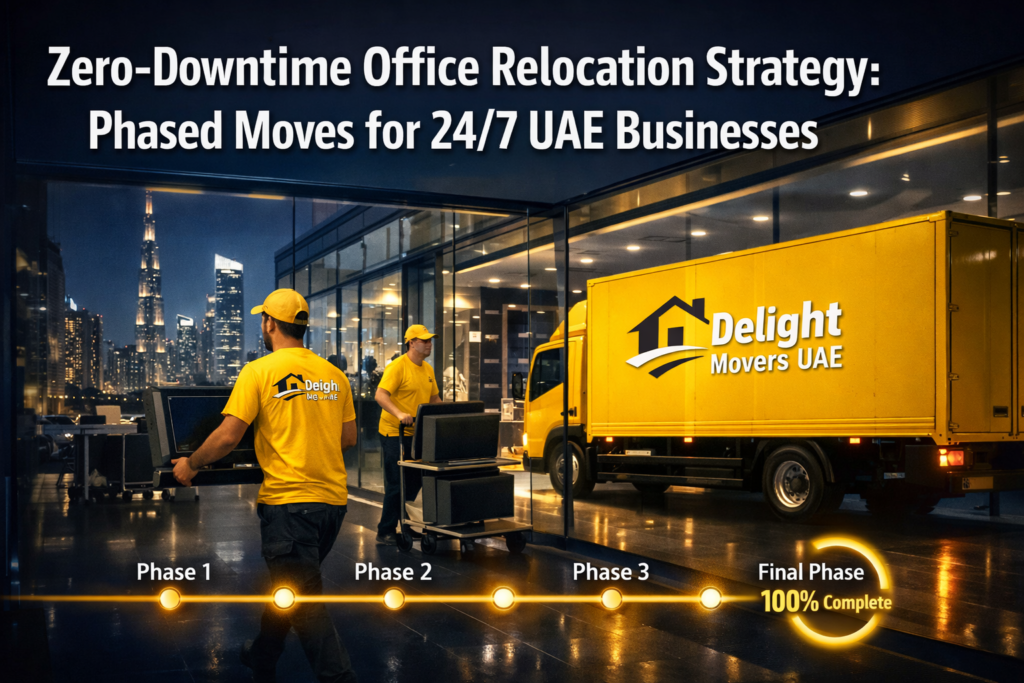
Zero-downtime relocation represents a fundamental shift from traditional moving methodologies. Rather than shutting down operations completely, this approach segments the move into carefully planned phases that allow different departments or functions to relocate while others continue normal operations.
The UAE business environment makes this approach particularly relevant. Dubai’s office market recorded 3,150 office sales in 2024 worth AED 6.8 billion, representing a 36% appreciation and 7.1% increase in transaction volume year-over-year[2]. With average office sale prices reaching AED 1,550 per square foot and rental rates at AED 145 per square foot[2], businesses are constantly optimizing their workspace strategies, making professional relocation expertise essential.
What Makes UAE Office Moves Unique
Several factors distinguish office relocations in the Emirates from moves in other markets:
- Regulatory complexity: Different Emirates and free zones maintain distinct access protocols, timing restrictions, and documentation requirements.
- Building access constraints: Premium commercial towers in Business Bay, DIFC, and Downtown Dubai enforce strict loading bay schedules and elevator reservations.
- Climate considerations: Extreme heat during summer months necessitates climate-controlled transport for sensitive equipment.
- Multicultural workforce: International teams require clear communication and minimal disruption to maintain productivity across time zones.
- Technology dependence: Modern UAE offices rely heavily on integrated IT infrastructure that cannot tolerate extended outages.
Professional office movers in Dubai understand these nuances and design phased strategies that address each challenge systematically.
The Business Case for Phased Office Relocation
Calculating the True Cost of Downtime
Before evaluating office movers cost, UAE business leaders must first understand the financial impact of operational disruption. Consider these factors:
- Revenue loss: A call center handling 200 transactions hourly at AED 150 average value loses AED 30,000 per hour of downtime.
- Productivity drain: Even partial disruption reduces employee output by 40-60% during traditional moves.
- Client relationship damage: Service interruptions erode trust built over years, with recovery taking months.
- Contractual penalties: Many UAE enterprises face SLA penalties for service disruptions, adding direct financial costs.
- Competitive disadvantage: In fast-moving markets, even brief unavailability sends clients to competitors.
A mid-sized financial services firm in DIFC calculated that a three-day shutdown would cost approximately AED 450,000 in direct revenue loss, plus an estimated AED 200,000 in productivity reduction and client relationship impact. Against this backdrop, investing AED 15,000-20,000 in professional zero-downtime relocation becomes a clear financial advantage.
Market Growth Driving Demand
The UAE movers market is projected to reach USD 835.2 million by 2028, driven by intensive property development and expatriate influx[5]. Over 10,000 new townhouses and villas are being launched by 2025, significantly escalating the need for professional moving services[5]. The transport sector in the UAE increased by 12.6% in the first eight months of 2024 compared to the prior year[5].
This growth reflects increasing recognition that professional movers and packers deliver value far beyond simple transportation. They provide strategic planning, risk mitigation, and operational continuity that protect business interests during transitions.
Strategic Planning: The Foundation of Zero-Downtime Moves
Successful phased relocation begins months before the first box is packed. Professional office movers and packers follow a structured planning methodology that addresses every operational dimension.
Phase 1: Comprehensive Assessment and Strategy Development
The planning process starts with detailed assessment:
- Current state documentation: Complete inventory of workstations, IT infrastructure, furniture, specialized equipment, and storage requirements.
- Operational mapping: Understanding which functions are mission-critical, which can tolerate brief interruptions, and which require continuous availability.
- Dependency analysis: Identifying relationships between systems, departments, and processes that must remain intact.
- Timeline constraints: Mapping business cycles, peak periods, and optimal windows for each phase.
- Budget allocation: Determining realistic investment levels for different service tiers.
For enterprises with complex operations, this assessment phase typically requires 2-4 weeks and involves collaboration between office movers, IT teams, facilities management, and business unit leaders.
Phase 2: Sequencing and Scheduling
Once assessment is complete, professional movers develop a detailed phased timeline. Common sequencing approaches include:
Departmental Phasing: Moving one department at a time while others continue operations. Customer service moves first weekend, finance moves second weekend, operations moves third weekend.
Functional Phasing: Relocating by function rather than department. IT infrastructure migrates first (establishing connectivity at new location), then workstations, then support facilities.
Geographic Phasing: For multi-floor offices, moving one floor at a time with temporary consolidation of remaining staff.
Hybrid Phasing: Combining approaches based on specific business requirements and building constraints.
The office relocation planning process must also account for UAE-specific factors like loading bay availability, building management approvals, and access timing restrictions that vary significantly across Emirates and free zones.
Executing Phased Moves: Operational Best Practices
Weekend and After-Hours Execution
The majority of zero-downtime office relocations occur outside standard business hours. Professional movers and packers typically execute moves during these windows:
- Friday evenings to Saturday mornings: Leveraging the UAE weekend for maximum uninterrupted time.
- Weeknight shifts: 6 PM to 6 AM windows for incremental phases.
- Holiday periods: Capitalizing on Eid breaks or year-end holidays when possible.
This timing strategy requires movers with flexible scheduling capabilities and teams trained for efficient night operations. The night work protocols followed by experienced providers ensure safety, security, and quality even during unconventional hours.
IT Infrastructure Migration
Technology systems represent the most critical component of phased office moves. Best practices include:
Pre-migration preparation: Complete backup of all data, documentation of current configurations, labeling of every cable and connection point.
Parallel operation period: Establishing connectivity at the new location before dismantling existing infrastructure, allowing testing and validation.
Staged cutover: Moving non-critical systems first, then progressively migrating mission-critical applications with minimal downtime windows.
Immediate validation: Testing each system component as it’s installed at the new location, identifying and resolving issues before they impact operations.
Many enterprises partner with specialized IT relocation teams who work alongside office movers to ensure technical continuity. For complex environments, this coordination is essential.
Inventory Management and Tracking
Professional movers and packers employ sophisticated tracking systems that provide real-time visibility throughout phased relocations:
- Color-coded labeling: Different phases receive distinct color codes, making it immediately clear which items move when.
- Digital inventory: Barcode or RFID tracking of every item, accessible via mobile apps and web dashboards.
- Photographic documentation: Before and after photos of high-value items and complex equipment setups.
- Chain of custody: Clear accountability for every item from original location through transport to final placement.
This level of tracking becomes particularly important when moves span multiple weekends or involve temporary storage between phases.
Cost Structure and Investment Planning
Understanding Office Movers Cost Components
Small to mid-sized office relocations in Dubai average AED 1,000 to AED 5,000, depending on distance, office size, number of workstations, and service type[4]. Corporate or multi-floor office moves typically cost AED 7,000 to AED 12,000, particularly when including IT dismantling, reinstallation, and insurance coverage[4].
For zero-downtime phased relocations, costs typically fall into these categories:
Base Moving Services (40-50% of total cost):
- Labor for packing, loading, transport, and unpacking
- Vehicle fleet and fuel
- Basic packing materials
- Standard insurance coverage
Premium Service Components (30-40% of total cost):
- After-hours and weekend premium rates
- Specialized IT handling and reconnection
- Project management and coordination
- Enhanced insurance for high-value equipment
- Temporary storage between phases
Building and Regulatory Compliance (10-15% of total cost):
- Loading bay reservations and deposits
- Elevator booking fees
- Building access permits
- Security deposits
- NOC processing for certain Emirates
Contingency and Risk Mitigation (5-10% of total cost):
- Buffer for unexpected challenges
- Backup equipment and resources
- Extended insurance coverage
The comprehensive office moving cost breakdown shows how these components vary based on office size, complexity, and timing requirements.
Route-Specific Cost Considerations
Geographic factors significantly impact office movers cost in the UAE:
Intra-Dubai moves: Shortest distances but often highest building access complexity. Business Bay to DIFC moves face strict timing windows and premium loading bay fees.
Dubai to Abu Dhabi: Longer distance increases transport time and fuel costs. NOC requirements and timing coordination add administrative complexity.
Dubai to Northern Emirates: Routes to Sharjah, Ajman, RAK, or UAQ offer cost advantages but require careful route planning and compliance with different emirate regulations.
Free Zone relocations: Moves involving DMCC, JAFZA, DIFC, or other free zones require specialized compliance knowledge and documentation.
Technology-Enabled Relocation Management
Modern office movers and packers leverage technology platforms that transform the relocation experience:
Digital Planning Tools: Interactive floor plans allow clients to visualize new layouts, assign workstations, and plan department placement before the move begins.
Real-Time Tracking: GPS-enabled vehicles and digital inventory systems provide live updates on item locations and move progress.
Communication Platforms: Dedicated project portals keep all stakeholders informed with automated notifications, milestone updates, and instant issue escalation.
Post-Move Analytics: Detailed reports document timeline adherence, cost accuracy, and service quality metrics that inform future relocations.
These technology capabilities differentiate professional providers from basic moving services, particularly for complex phased relocations requiring precise coordination.
Risk Management and Insurance Considerations
Comprehensive Coverage for Business Assets
Standard moving insurance typically covers AED 10-20 per kilogram for general office contents. For zero-downtime relocations involving high-value equipment, enhanced coverage becomes essential:
- IT equipment coverage: Servers, workstations, networking gear often valued at AED 500,000-2,000,000 for mid-sized offices.
- Specialized equipment: Medical devices, laboratory equipment, manufacturing tools require specific coverage.
- Business interruption insurance: Protects against revenue loss if unexpected delays occur.
- Professional liability: Covers errors in IT reconnection or system configuration.
Understanding office moving insurance options helps businesses make informed decisions about risk transfer versus risk retention.
Contingency Planning
Professional movers and packers develop detailed contingency plans addressing potential disruptions:
- Building access delays: Backup timing windows if loading bays become unavailable.
- Equipment failures: Spare vehicles and backup equipment to maintain schedule.
- Technical issues: On-call IT specialists to resolve connectivity problems immediately.
- Weather contingencies: Climate-controlled alternatives if extreme heat threatens sensitive equipment.
These backup plans provide the confidence that operations will continue regardless of unexpected challenges.
Selecting the Right Office Movers and Packers
Evaluation Criteria for Zero-Downtime Capability
Not all moving companies possess the expertise, resources, and systems required for successful phased relocations. When evaluating providers, assess these critical capabilities:
Experience with Complex Moves: Request case studies of similar zero-downtime projects, including office size, industry, and specific challenges addressed.
Resource Availability: Confirm the provider maintains sufficient teams, vehicles, and equipment to execute after-hours moves without compromising quality.
Technology Systems: Evaluate tracking, communication, and project management platforms that will support your relocation.
Insurance and Licensing: Verify comprehensive coverage, proper licensing across relevant Emirates, and financial stability.
References and Reputation: Speak with previous clients who executed phased moves, focusing on timeline adherence and issue resolution.
Transparent Pricing: Detailed quotes that clearly itemize all cost components, avoiding vague estimates that lead to surprise charges.
The guide to choosing reliable office movers in Dubai provides additional evaluation frameworks for this critical decision.
Red Flags to Avoid
Certain warning signs indicate providers ill-equipped for zero-downtime relocations:
- Unwillingness to provide detailed written plans: Professional movers document every phase in writing.
- Lack of dedicated project manager: Complex moves require single-point accountability.
- No after-hours availability: Zero-downtime moves happen outside business hours by definition.
- Minimal insurance coverage: Inadequate protection for business-critical assets.
- Poor communication responsiveness: Delayed responses during planning predict problems during execution.
Understanding these red flags helps avoid costly mistakes in provider selection.
Emirates-Specific Relocation Considerations
Dubai Office Relocations
Dubai’s available office space is projected to reach 9.7 million square metres by the end of 2026, compared to 6.26 million square metres currently[2]. This rapid expansion creates both opportunities and challenges for relocating businesses.
Key considerations for Dubai moves include:
- Building access coordination: Premium towers in Business Bay, DIFC, and Downtown enforce strict protocols requiring advance booking.
- Traffic timing: Strategic scheduling around peak congestion periods minimizes transport time.
- Free zone compliance: Moves involving Dubai’s numerous free zones require specific documentation and procedures.
The comprehensive Dubai office relocation guide addresses these location-specific factors in detail.
Abu Dhabi Relocations
Abu Dhabi office moves involve distinct requirements:
- Tawtheeq registration: Certain moves require updated Tawtheeq documentation.
- Building management protocols: Different approval processes compared to Dubai.
- Distance factors: Moves from Dubai to Abu Dhabi require careful route planning and timing.
Professional Abu Dhabi office movers navigate these requirements efficiently, ensuring compliance and smooth execution.
Northern Emirates Opportunities
Relocations to Sharjah, Ajman, RAK, Fujairah, and UAQ often provide cost advantages while maintaining proximity to Dubai markets:
- Lower real estate costs: Significant savings on office space.
- Streamlined approvals: Generally faster building access coordination.
- Growing business ecosystems: Expanding commercial infrastructure in these Emirates.
However, each emirate maintains unique requirements. Ajman relocations offer SME advantages, while RAK moves require specific compliance knowledge.
Post-Move Optimization and Validation
Immediate Post-Move Priorities
The first 48 hours after each phase determines whether zero-downtime objectives are achieved:
System Validation: Comprehensive testing of IT infrastructure, telecommunications, security systems, and environmental controls.
Workspace Functionality: Verifying that workstations, meeting rooms, and support facilities are fully operational.
Employee Orientation: Ensuring teams understand new layouts, access procedures, and facility features.
Client Communication: Proactive outreach confirming uninterrupted service availability.
Issue Resolution: Immediate attention to any problems identified during initial operations.
Professional movers and packers remain engaged during this critical period, providing rapid response to any setup issues or adjustment needs.
Long-Term Optimization
Beyond immediate functionality, successful relocations create opportunities for operational improvement:
- Workflow enhancement: New layouts often enable process improvements impossible in previous space.
- Technology upgrades: Relocation provides natural timing for infrastructure modernization.
- Sustainability gains: Newer buildings typically offer better energy efficiency and environmental performance.
- Culture development: Thoughtful space design reinforces desired organizational culture and collaboration patterns.
These longer-term benefits multiply the value delivered by strategic relocation planning.
Case Study: Financial Services Firm Phased Relocation
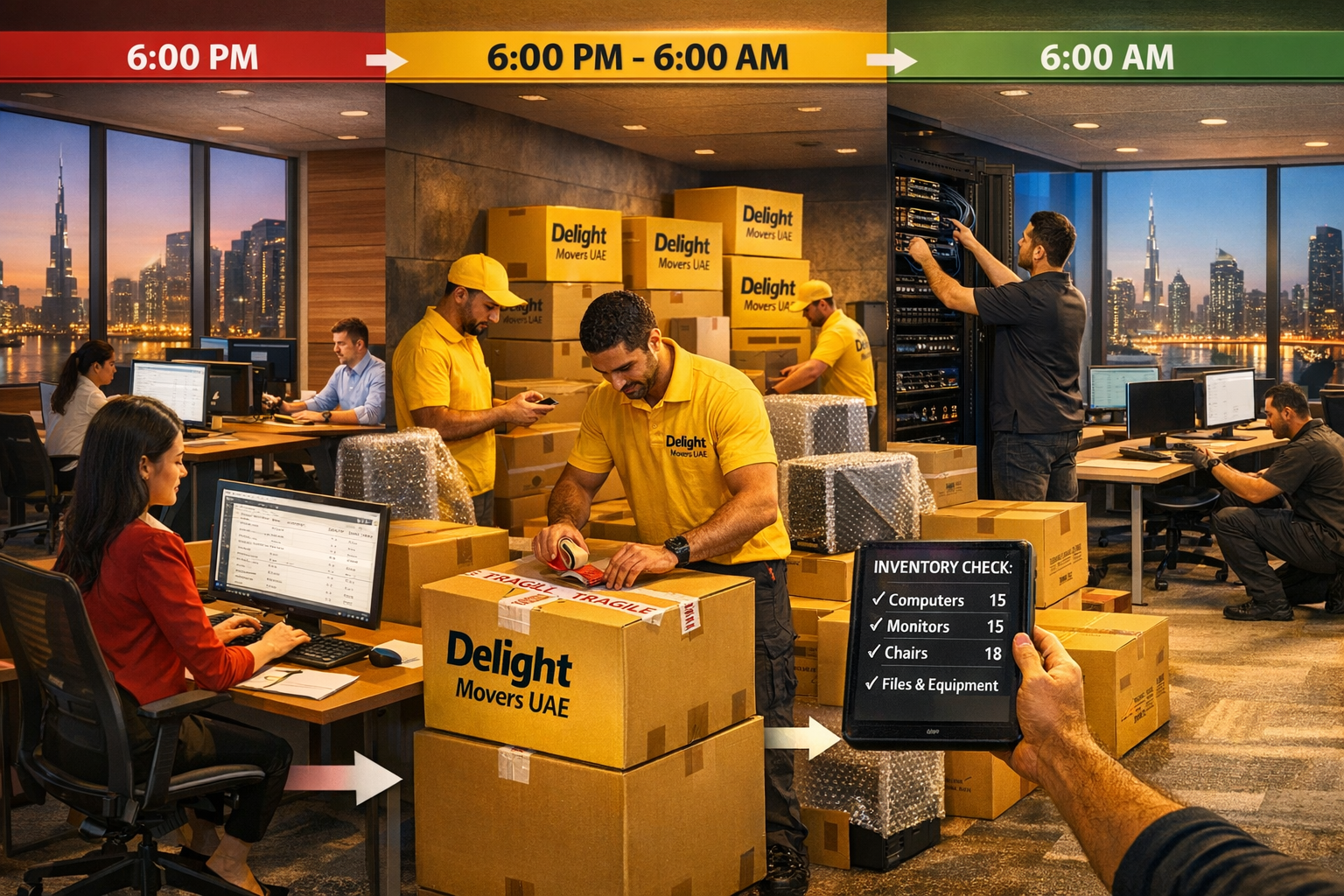
A Dubai-based financial services company with 120 employees needed to relocate from aging Business Bay offices to a modern DIFC tower while maintaining 24/7 trading operations serving international markets.
Challenge: Zero tolerance for system downtime during active trading hours. Complex IT infrastructure including trading platforms, compliance systems, and client portals. Strict regulatory requirements for data security and operational continuity.
Solution: Four-phase relocation executed over consecutive weekends:
Phase 1 (Weekend 1): IT infrastructure migration with parallel systems running at both locations. Network connectivity established and validated at new DIFC office.
Phase 2 (Weekend 2): Trading floor relocation during market closure window. Complete setup and testing before Monday market open.
Phase 3 (Weekend 3): Back-office functions including compliance, HR, and administration. Non-critical systems with flexible timing.
Phase 4 (Weekend 4): Final elements including executive offices, meeting rooms, and support facilities.
Results: Zero unplanned downtime. All trading operations continued without interruption. Client services maintained at full capacity throughout. Total project cost of AED 18,500 versus estimated AED 600,000+ cost of operational shutdown.
This case demonstrates how professional office movers and packers with zero-downtime expertise deliver measurable business value far exceeding their service fees.
Environmental and Sustainability Considerations
Modern UAE businesses increasingly prioritize environmental responsibility in all operations, including office relocations.
Sustainable Moving Practices
Professional movers and packers now offer eco-friendly options:
- Reusable packing materials: Plastic crates and containers replacing single-use cardboard.
- Furniture donation programs: Coordinating transfer of unwanted items to charities rather than disposal.
- Recycling services: Proper processing of electronics, paper, and other materials.
- Fuel-efficient vehicles: Modern fleets with lower emissions and better fuel economy.
- Optimized routing: Planning that minimizes total distance traveled and fuel consumption.
These practices align with UAE national sustainability goals while reducing environmental impact.
Circular Economy Approaches
Forward-thinking relocations incorporate circular economy principles:
- Furniture refurbishment: Updating existing pieces rather than replacing.
- Equipment repurposing: Finding new uses for items no longer needed in new space.
- Material recovery: Salvaging and reusing packing materials across multiple projects.
These approaches often reduce costs while delivering environmental benefits.
Future Trends in UAE Office Relocation
Technology Integration
Emerging technologies are transforming the relocation experience:
Augmented reality planning: Virtual walkthroughs of new spaces before moves begin, allowing precise planning and visualization.
IoT tracking: Real-time location and condition monitoring of every item throughout the move.
AI-powered scheduling: Optimization algorithms that identify ideal timing windows and resource allocation.
Automated inventory: Computer vision systems that document and track items without manual data entry.
Professional office movers and packers investing in these technologies will deliver increasingly sophisticated services in coming years.
Market Evolution
Several trends are reshaping the UAE moving industry:
- Specialization: Growing focus on specific niches like IT-heavy offices, medical facilities, or creative agencies.
- Integration: Moving services bundling with workspace design, IT setup, and facilities management.
- Flexibility: On-demand and modular services matching agile business models.
- Transparency: Real-time pricing and service visibility becoming standard expectations.
Businesses planning relocations should seek providers embracing these evolutionary trends.
Conclusion
Zero-downtime office relocation represents a strategic capability that enables UAE businesses to optimize their workspace without sacrificing operational continuity. Through careful phasing, professional execution, and technology-enabled coordination, enterprises can relocate while maintaining the seamless service delivery their clients expect.
The investment in professional office movers and packers with zero-downtime expertise delivers returns far exceeding the service cost. Avoided revenue loss, maintained productivity, preserved client relationships, and reduced business risk create compelling financial justification for this approach.
As Dubai’s office market continues its rapid expansion toward 9.7 million square metres by the end of 2026[2], and as sales and rental prices surge by approximately 25%[2], more businesses will evaluate relocation options. Those who approach these transitions strategically, partnering with experienced providers who understand phased methodologies, will capture the benefits of improved workspace while avoiding the traditional costs of moving disruption.
Next Steps for Your Zero-Downtime Relocation
Assess your requirements: Document current operations, identify mission-critical functions, and establish downtime tolerance levels.
Engage professional movers early: Begin conversations 3-6 months before target move dates to allow proper planning.
Request detailed proposals: Obtain comprehensive quotes that itemize all cost components and outline phased approaches.
Validate capabilities: Review case studies, check references, and verify insurance and licensing.
Develop detailed plans: Work with your chosen provider to create phase-by-phase timelines addressing every operational dimension
Communicate proactively: Keep employees, clients, and stakeholders informed throughout the planning and execution process.
Execute with confidence: Trust the expertise of professional movers and packers while maintaining oversight of critical milestones.
Delight Movers brings extensive experience in zero-downtime office relocations across all UAE Emirates. Our technology-enabled approach, comprehensive insurance coverage, and proven phased methodologies have supported dozens of successful relocations for businesses that cannot afford operational interruption. Contact our team to discuss your specific requirements and receive a detailed proposal tailored to your unique situation.
Frequently Asked Questions
How long does a typical phased office relocation take in Dubai?
What is the cost difference between traditional and zero-downtime office moves?
Can IT systems really be moved without downtime?
What happens if unexpected issues arise during a phased move?
Do all UAE Emirates have the same relocation requirements?
How far in advance should we book zero-downtime office movers?
What insurance coverage is recommended for office relocations?
Can we relocate during our peak business season?
Office Movers Cost Calculator - Zero-Downtime Relocation
Zero-Downtime Office Movers Cost Calculator
Get instant estimates for phased office relocation across UAE
Your Estimated Office Moving Cost
AED 0
Estimated Total Investment
Base Moving Cost
AED 0
Service Premium
AED 0
Route Distance
AED 0
Phasing Coordination
AED 0
Important: This is an estimated range based on typical projects. Final costs depend on specific requirements including IT complexity, building access, insurance needs, and timing constraints. Contact Delight Movers for a detailed quote tailored to your exact specifications.