

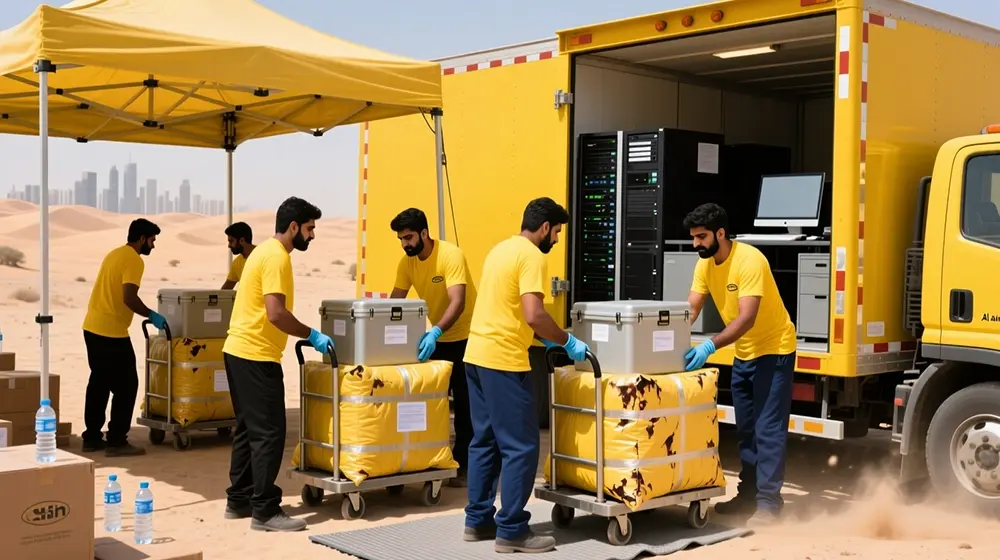
A Dubai to Al Ain office move is a heat-sensitive inter-emirate relocation that requires pre-dawn departures, temperature-controlled cargo handling, MOHRE midday-break compliance, and strict adherence to Al Ain compound access rules. The Dubai–Al Ain corridor exposes office cargo to rapid temperature escalation, desert crosswinds, and solar radiation levels that place IT hardware, laminated furniture, paper archives, and glass partitions at high thermal risk. Because Al Ain gated compounds allow heavy-vehicle entry only in morning unloading windows, every timing decision:from the start of packing to the moment the truck reaches the compound gate:must be calculated backward from these restricted access slots. Early-hour movement protects workers under UAE heat-safety regulations, stabilizes server and electronics temperature, and prevents cargo overexposure inside sealed trucks. This introduction provides a detailed operational overview of how desert heat dynamics, labor regulations, cargo cooling requirements, and controlled-access procedures combine to shape the structure of a Dubai to Al Ain office move.
Also Read : dubai to abu dhabi office move,abu dhabi office move,tamm noc for office move
What is a Dubai to Al Ain office move?
A Dubai to Al Ain office move is an inter-emirate commercial relocation that requires heat-protected cargo handling, regulated labor timing, and controlled compound access coordination in Al Ain’s gated districts. The relocation covers approximately 136 km across the E66 Dubai–Al Ain Road, a desert corridor where ambient temperatures, solar load, and low-humidity conditions directly influence equipment safety and transport performance. Moves must align with MOHRE heat-safety rules, meet Al Ain compound gate-pass procedures, and complete morning-only unloading to avoid high-heat operational windows. Because Al Ain communities enforce strict movement control for heavy trucks, the entire relocation must be scheduled backward from the compound’s access timetable.
Why does desert heat create major risks during a Dubai to Al Ain office move?
Desert heat creates major relocation risks because rapid temperature increases cause equipment overheating, adhesive failure, laminate distortion, and condensation inside sealed trucks. The Dubai–Al Ain desert section shows morning temperature increases of 11–15°C within three hours, with sealed cargo boxes heating even faster. Server racks, hard drives, and LCD screens experience thermal stress above 38–40°C. Laminated wooden desks begin edge lifting once internal temperature reaches 45°C. Printer inks, toner cartridges, and chemical-based supplies expand with heat and leak when exposed to thermal fluctuation. Packing tape adhesives soften and lose grip under prolonged direct heat. Paper records curl when humidity swings inside the truck.

Why do movers rely on pre-dawn departures for Dubai to Al Ain relocations?
Movers rely on pre-dawn departures because the 04:00–06:00 travel window offers the lowest temperatures, the most stable truck-cabin conditions, and the highest probability of reaching Al Ain compounds before morning unloading ends. Pre-dawn surface temperatures remain 10–14°C lower than typical mid-morning levels. Wind patterns before sunrise reduce dust intrusion into loading areas. Traffic density remains minimal on Sheikh Mohammed bin Zayed Road and the E66 highway, enabling uninterrupted movement. Early movement also protects movers from heat fatigue and ensures cargo remains below critical thermal thresholds before sunrise intensifies heat radiation.
How does the MOHRE midday break rule shape the entire moving schedule?
The MOHRE midday break rule shapes the schedule by legally prohibiting any outdoor labor between 12:30 and 15:00, forcing all loading and unloading to finish before 12:00. This regulation applies annually during UAE summer months and directly impacts office-moving teams, because furniture lifting, handling, and transport-docking are outdoor activities. Violating the rule results in fines, work stoppages, and operational delays. Therefore, movers design a schedule that completes Dubai loading by 04:00–05:00, arrives in Al Ain by 07:30–08:00, and finishes unloading by 11:30–12:00, ensuring compliance and worker safety.
What is cargo cooling and why is it critical for this inter-emirate route?
Cargo cooling is the controlled-temperature system used to stabilize IT hardware, furniture, and sensitive office materials during desert transit.
Effective cargo cooling includes:
- Pre-cooled truck cabin: Trucks are cooled 20–30 minutes before loading to create a stable baseline temperature.
- Thermal blankets: Reflective multilayer blankets reduce heat penetration and stabilize equipment temperature.
- Insulated server crates: Servers are wrapped with double-layer insulation to eliminate heat pockets.
- Ventilated stacking: Movers leave airflow gaps between electronic items to prevent thermal buildup.
- Radiation shields: Heat-resistant foam padding blocks infrared radiation on the sun-facing side of the truck.
- Reduced stacking density: Lower density prevents vertical heat accumulation inside the cargo area.
- Shorter truck-idling periods: Truck engines and sun exposure raise cabin temperature during idling, so movers minimize stops.
These measures preserve the operational lifespan of electronics and prevent structural distortion of furniture materials.
Which office assets require the highest thermal protection on this route?
Servers, IT racks, monitors, UPS units, modems, communication routers, printers, chemical supplies, glass partitions, and compressed-wood desks require the highest thermal protection.
Detailed sensitivities:
- Servers: CPU and HDD temperatures destabilize above 38°C.
- LCD monitors: Liquid crystals distort under heat, causing discoloration and pixel issues.
- UPS batteries: Lead-acid and lithium-ion batteries lose 50% efficiency at 45°C.
- Printers & cartridges: Ink expands under desert heat, risking leaks.
- Glass partitions: Become brittle under rapid thermal shift.
- Laminate desks: Edge-banding loosens above 40°C.
- Cable insulation: Hardens or softens depending on heat load.
Also Read : Office Relocation in Dubai: Loading Bay Protocols, Night Moves & Zero-Downtime Plan

How do Al Ain compound access rules determine the move’s timing?
Al Ain access rules determine timing because compounds enforce restricted entry periods, gate pass verification, and escorted truck movement, making precise arrival essential.
Typical requirements include:
- Pre-approved gate pass
- Driver Emirates ID
- Company trade license copy
- Truck number plate registration
- Lift booking documents
- Access fee (if applicable)
- Receiver’s contact for verification
- Security check-in log entry
- Mandatory noise-control adherence
Most Al Ain compounds grant truck entry only between 08:00 and 12:00, creating a non-negotiable timing window.
Why are morning-only unloading slots standard in Al Ain zones?
Morning-only unloading slots are standard because Al Ain communities prioritize heat safety, traffic control, and resident comfort, making early-hour operations the safest and least disruptive. Heat levels rise sharply after 11:00, limiting safe outdoor work. Compounds prevent heavy vehicle circulation during midday to avoid noise and congestion. This scheduling also reduces accidental heat damage to fragile cargo.
What route conditions must movers monitor on the Dubai–Al Ain corridor?
Movers monitor temperature zones, road-surface heat levels, police checkpoints, E66 congestion segments, and desert crosswinds that impact truck stability.
Key route details:
- E66 Desert Sector: Peak thermal zone between km 40–80.
- Academic City section: Higher traffic, requiring early departure to avoid queues.
- Al Faqa area: Crosswinds create lateral pressure on tall trucks.
- E102 connector: Optional path if E66 slows due to construction.
- Truck rest areas: Must be avoided during heat peaks to prevent overheating due to idling.
How do movers prepare both Dubai and Al Ain buildings for seamless movement?
Movers prepare buildings by coordinating FM approvals, loading bay reservations, hallway protection, lift padding, and security desk notifications.
Preparation steps include:
- Protective sheets on floors
- Doorframe guards
- Lift interior wrapping
- Parking bay reservation
- Lobby path clearance
- CCTV notification for access logging
- Fire-exit clearance check
- Tenant coordination for noise windows
- Lift operator assignment (if required)
Buildings in Al Ain usually need 24–48 hours notice to approve truck entry.
Also Read : Business & office moving services in dubai
How do movers handle fragile assets for a desert move?
Movers handle fragile assets using foam-lined containers, triple-edge cushioning, anti-shatter films, and vibration-damping pads.
Glass and partitions are packed upright with four layers:
- Foam
- Corrugated board
- Reinforced corner protectors
- Shock-absorbing membrane
Electronics receive:
- Anti-static covers
- Insulated boxes
- Temperature indicator strips
- Position labels to reduce mishandling
How do movers maintain safe working conditions during extreme temperatures?
Movers maintain safety using hydration cycles, mandatory breaks, shaded staging areas, early-hour scheduling, and MOHRE-compliant task rotation.
Teams carry electrolyte supplies and monitor worker fatigue during heavy-lift tasks. Supervisors track temperature rise and enforce cooldown intervals.
What is the complete operational timeline for a compliant Dubai to Al Ain move?
A compliant timeline ensures early loading, controlled transit, and morning unloading in Al Ain.
Standard Timing Sequence
- 03:30–04:00 : Team arrival, safety briefing, lift padding
- 04:00–05:00 : Complete loading under cool conditions
- 05:00–07:30 : Transit via E66 with minimized stops
- 07:40–08:00 : Arrive at Al Ain compound gate
- 08:00–12:00 : Full unloading inside allowed window
- 12:30–15:00 : MOHRE midday break begins; no outdoor activity allowed
This schedule is non-negotiable for heat compliance.
What happens if movers miss timing windows or access slots?
Missing timing windows results in truck entry refusal, extended idling under heat, cargo overexposure, FM penalties, or rescheduling for the next day. Heat exposure inside a static truck increases by 18–20°C within one hour of sun contact, making delays dangerous for sensitive cargo.
Summary
A Dubai to Al Ain office move requires controlled-temperature packing, pre-dawn departures, MOHRE-compliant scheduling, and strict adherence to Al Ain’s morning-only unloading rules to ensure safe and interruption-free relocation. The desert corridor demands specialized protection for electronics, server systems, furniture materials, and fragile items. Access rules inside Al Ain compounds require pre-approved documentation, gate passes, lift bookings, and exact arrival timing. By planning loading at 04:00, traveling before sunrise, cooling cargo, and finishing unloading before midday heat, businesses achieve a safe, fully compliant, and efficient inter-emirate office relocation.


