
Relocating your office within the UAE’s free zones demands more than hiring professional movers. The regulatory landscape has transformed dramatically with new legislation, creating both opportunities and compliance traps for business leaders. One misstep in understanding office relocation rules can trigger penalties, visa cancellations, and operational disruptions that cost far more than any office movers cost you initially budgeted.
The introduction of Federal Decree-Law No. 20 of 2025 fundamentally changed how companies approach free zone office relocation, establishing formal re-domiciliation procedures that preserve corporate identity while navigating complex jurisdictional boundaries. Whether you’re moving between DMCC and DIFC or transitioning from mainland to JAFZA, understanding these regulations protects your business continuity and employee welfare.
This comprehensive guide walks through the exact compliance requirements, NOC processing timelines, and cost considerations for office movers and packers operating across Dubai and Abu Dhabi’s major free zones.
Key Takeaways
- Free zone office relocation now follows formal re-domiciliation procedures under Federal Decree-Law No. 20 of 2025, allowing companies to retain legal identity and corporate history when moving between jurisdictions.
- Each free zone maintains distinct NOC processing timelines, visa quota policies, and physical office requirements that directly impact your relocation strategy and office movers cost.
- Employee transitions between mainland and free zones require complete work permit cancellations and re-hiring procedures, with mandatory settlement of all end-of-service benefits before relocation.
- Non-compliance penalties vary significantly by zone, with DIFC and ADGM imposing stricter data protection requirements and higher legal costs compared to industrial free zones like JAFZA.
- Successful office relocation demands coordination between professional movers, legal advisors, and zone-specific relocation desks, with typical processing timelines ranging from 5 to 21 business days depending on jurisdiction.
Understanding UAE Free Zone Office Relocation Framework in 2026
The regulatory environment governing office relocation across UAE free zones has matured significantly. Business owners must now navigate a sophisticated framework that balances operational flexibility with strict compliance requirements.
The Re-Domiciliation Revolution
Federal Decree-Law No. 20 of 2025 introduced a formal re-domiciliation regime that fundamentally changed how companies relocate their legal seat between Emirates, mainland authorities, and free zones. This legislation allows businesses to transfer their registered office while retaining legal identity, corporate history, and accumulated assets[1].
The re-domiciliation process requires a special resolution by the general assembly and approval from competent authorities in both the transferring and receiving jurisdictions. This represents a significant departure from previous practices where companies often had to dissolve and re-establish entities, losing valuable corporate history and contractual continuity[1].
For businesses planning office relocation, this framework provides legal certainty but demands meticulous documentation. Shareholder consent becomes non-negotiable, and the approval timeline varies based on the specific free zones involved.
Physical Office Location Mandates
Free zone entities must maintain a physical office or flexi-desk within the boundaries of their specific free zone. Operating a free zone license from a mainland office space remains prohibited unless you register a separate mainland branch[2].
This requirement directly impacts your office movers and packers selection. The physical relocation must align with license transfer timing to avoid compliance gaps. Many businesses make the critical error of securing new office space before obtaining regulatory approvals, creating unnecessary holding costs.
Physical office requirements by zone:
- DMCC: Flexi-desk options available with full license validity
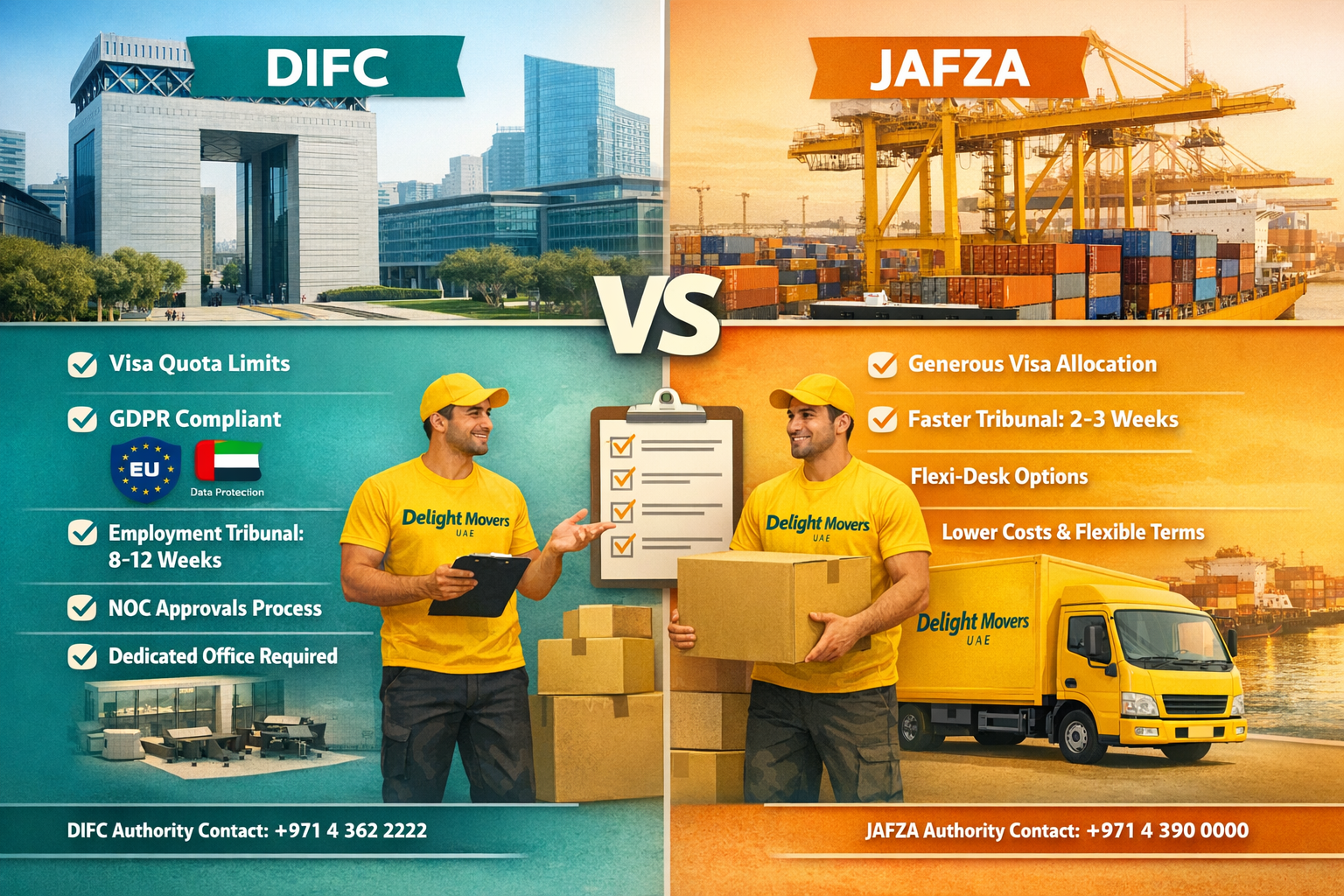
- DIFC: Dedicated office space required for visa issuance
- JAFZA: Flexible workspace solutions permitted for service companies
- ADGM: Minimum square footage requirements based on business activity
The distinction between flexi-desk and dedicated office arrangements significantly affects both your office movers cost and ongoing operational expenses. DMCC’s flexi-desk model offers cost efficiency for small teams, while DIFC’s dedicated space requirements suit financial services firms requiring client-facing facilities.
Professional office movers familiar with free zone regulations understand these nuances. When coordinating your move, ensure your relocation partner has experience with your specific free zone’s access protocols, loading bay reservations, and timing restrictions.
For businesses considering broader relocation strategies across multiple Emirates, our office relocation Abu Dhabi guide provides detailed insights into cross-emirate compliance requirements.
Employee Transition Complexities
Moving employees from mainland to free zone or between different free zones involves canceling MoHRE work permits and obtaining new Free Zone Authority permits. The two jurisdictions fall under different regulatory bodies, creating administrative complexity that many business leaders underestimate[2].
The employee transition process requires:
- Formal resignation or termination from current entity
- Settlement of all end-of-service gratuities and accrued benefits
- Work permit cancellation with MoHRE or current Free Zone Authority
- Medical fitness tests and Emirates ID updates
- New employment contract execution
- Fresh work permit application with receiving Free Zone Authority
This “cancel and re-hire” procedure creates a critical vulnerability period where employees technically lack valid work authorization. Coordinating the timing requires precision to minimize this gap and maintain business continuity.
The current entity must pay all end-of-service gratuities, accrued vacation pay, and outstanding salaries before canceling work permits. This settlement obligation represents a significant cash flow consideration that businesses must budget alongside their office movers cost[2].
Labor dispute resolution timelines differ dramatically by zone. DIFC’s Employment Dispute Resolution Tribunal resolves disputes in 8-12 weeks, while most other Free Zone Authority tribunals operate faster. However, legal representation costs run higher in financial free zones, ranging from AED 15,000 to 30,000 versus AED 8,000 to 15,000 in mainland courts[4].
For companies managing office relocation alongside employee transitions, understanding these cost differentials helps budget appropriately. The total relocation expense extends far beyond what movers and packers charge for physical furniture transfer.
DMCC Office Relocation Rules and Compliance Requirements
Dubai Multi Commodities Centre remains one of the UAE’s most business-friendly free zones, but its office relocation procedures demand strict adherence to specific protocols.
DMCC NOC Processing Timeline
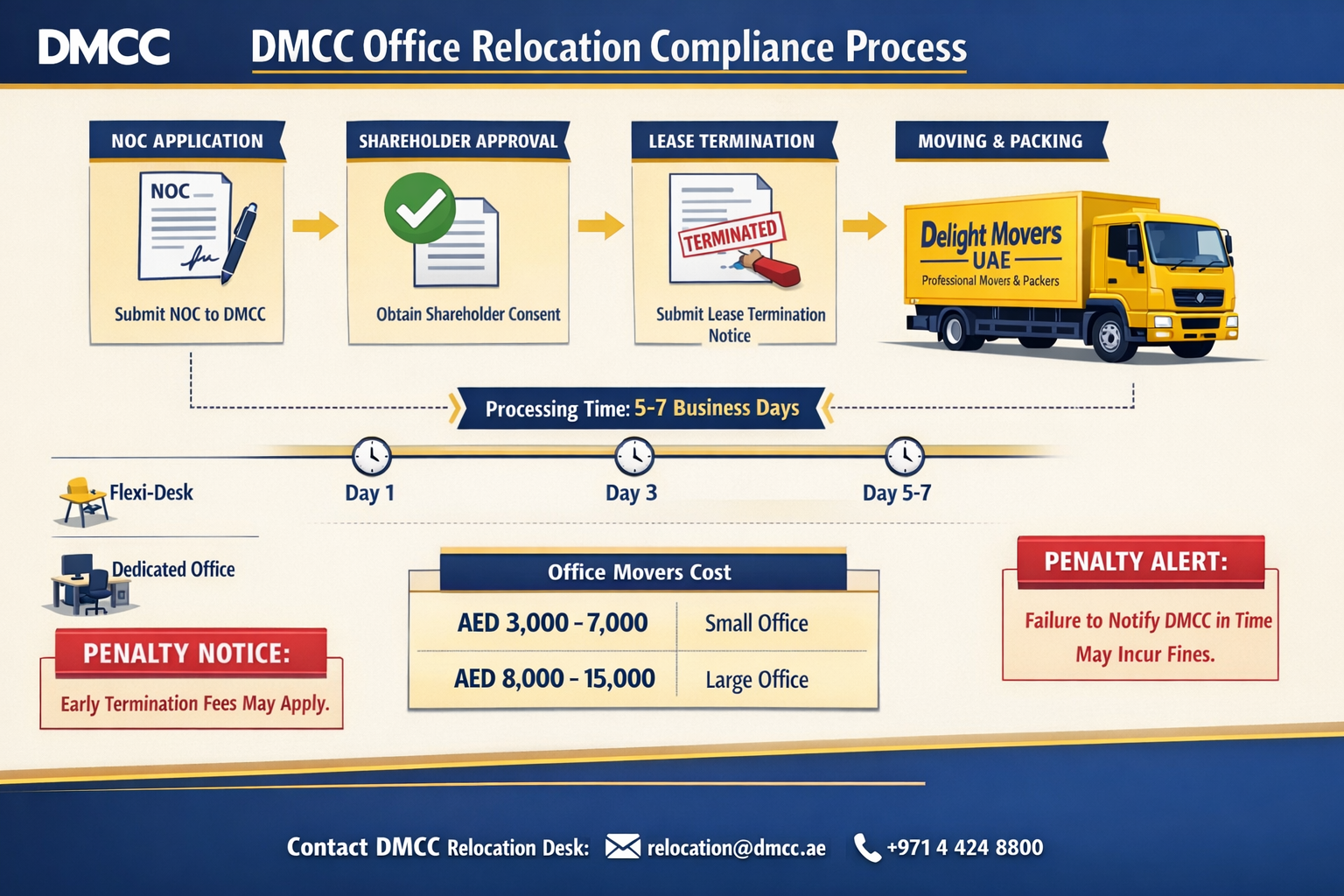
The No Objection Certificate application process at DMCC typically requires 5-7 business days for standard office relocations within the free zone. Inter-zone relocations or mainland-to-DMCC transitions extend this timeline to 10-14 business days[5].
DMCC NOC application requirements:
- Valid trade license copy
- Current tenancy contract
- New premises lease agreement or flexi-desk confirmation
- Board resolution authorizing relocation
- Shareholder consent documentation
- Outstanding fee clearance certificate
DMCC’s online portal streamlines much of the application process, but physical document submission remains necessary for certain transaction types. Business owners should initiate the NOC process at least three weeks before their intended move date to accommodate potential delays.
The DMCC relocation desk operates from their main office at Almas Tower. Direct contact details: +971 4 424 3200 or relocations@dmcc.ae. Their customer service team provides pre-application consultations that help identify potential compliance issues before formal submission.
Visa Quota Flexibility
DMCC offers generous visa quotas compared to other free zones. Basic flexi-desk licenses provide up to six visa allocations, making DMCC attractive for growing teams that haven’t yet committed to dedicated office space[4].
This flexibility creates strategic advantages for businesses timing their office relocation. Companies can maintain flexi-desk arrangements while scaling their team, then transition to dedicated offices when headcount justifies the additional expense.
The visa quota directly impacts your relocation strategy. If your current DMCC setup already maximizes available visas, upgrading to larger office space becomes mandatory before hiring additional staff. Coordinating this upgrade with your office movers ensures seamless transition without visa application delays.
Cost Considerations for DMCC Office Moves
Office movers cost for DMCC relocations varies based on office size, furniture volume, and timing requirements. Standard moves within DMCC range from AED 3,000 to AED 8,000 for small offices (up to 10 workstations), while larger operations with 50+ workstations typically cost AED 15,000 to AED 35,000[19].
Additional DMCC relocation costs:
- NOC processing fee: AED 500-1,000
- New lease registration: AED 1,500-3,000
- Ejari renewal: AED 220
- Visa transfer processing: AED 500 per employee
- Professional movers insurance: 2-3% of declared value
DMCC’s centralized location in Jumeirah Lakes Towers creates specific logistical considerations. Loading bay access requires advance booking, typically 48-72 hours notice during peak business periods. Weekend moves often incur premium charges from movers and packers but eliminate business disruption.
Businesses relocating from DMCC to other free zones should review our office relocation Dubai guide for insights on loading bay coordination and after-hours moving strategies that minimize downtime.
Penalties for Non-Compliance
DMCC enforces strict penalties for operating from unauthorized locations or failing to update registered office addresses. Violations typically result in:
- AED 5,000 initial warning fine
- AED 10,000 for continued non-compliance after 30 days
- License suspension after 60 days of violation
- Potential license cancellation for persistent violations
These penalties far exceed typical office movers cost, making compliance the economically rational choice. The reputational damage from license suspension creates additional indirect costs through disrupted client relationships and banking complications.
DIFC and JAFZA Office Relocation Protocols
The Dubai International Financial Centre and Jebel Ali Free Zone represent distinct regulatory environments, each with specialized office relocation requirements.
DIFC Regulatory Framework
DIFC operates under common law jurisdiction with stringent compliance standards that reflect its status as a leading financial center. Office relocation within DIFC or from external jurisdictions requires navigating both DIFC Authority administrative procedures and regulatory body approvals.
DIFC office relocation checklist:
- DIFC Registrar of Companies NOC application
- Financial Services Regulator notification (for regulated entities)
- Data Protection Commissioner compliance review
- Current lease termination documentation
- New premises fit-out approval
- Building management coordination
The DIFC Registrar processes standard NOC applications within 7-10 business days, but regulated financial services firms face extended timelines of 14-21 days due to additional regulatory oversight[5].
DIFC’s data protection regime creates unique compliance requirements for office relocation. The UAE mainland is not on DIFC’s adequacy list, meaning data transfers between DIFC and mainland operations require appropriate contractual safeguards such as Standard Contractual Clauses or Binding Corporate Rules[3].
For businesses relocating servers or data storage infrastructure, this requirement demands legal review before physical office movers begin work. The data protection compliance timeline often becomes the critical path item, not the physical relocation logistics.
Contact the DIFC relocation desk at: The Gate, Level 14, DIFC, Dubai. Phone: +971 4 362 2222. Email: operations@difc.ae.
JAFZA Operational Requirements
Jebel Ali Free Zone accommodates both commercial and light industrial operations, creating more flexible office relocation protocols compared to DIFC’s financial focus.
JAFZA’s NOC processing typically completes within 5-7 business days for intra-zone moves. Mainland-to-JAFZA transitions require 10-14 business days due to additional documentation requirements[5].
JAFZA-specific relocation considerations:
- Industrial zone access requires vehicle gate passes
- Loading/unloading permitted only in designated areas
- Hazardous material declarations for certain business types
- Customs documentation for imported office equipment
- Security clearance for IT equipment relocation
JAFZA’s generous visa allocation policies provide significant advantages for labor-intensive operations. Unlike DIFC’s requirement for dedicated office space per visa, JAFZA permits higher visa-to-square-meter ratios, reducing occupancy costs[4].
The physical distance between JAFZA and Dubai’s central business districts creates logistical considerations for office movers and packers. Transportation time from JAFZA to areas like Business Bay or DIFC can exceed 45-60 minutes during peak traffic, impacting move scheduling and potentially requiring multi-day relocation strategies for large offices.
Businesses coordinating moves between Dubai’s commercial centers and JAFZA should reference our movers in Business Bay guide for insights on cross-zone logistics.
JAFZA relocation desk contact: JAFZA One Building, Jebel Ali, Dubai. Phone: +971 4 881 4444. Email: customercare@jafza.ae.
Comparative Cost Analysis: DIFC vs JAFZA
Office movers cost varies significantly between these zones due to accessibility, security protocols, and operational complexity.
| Cost Component | DIFC Range | JAFZA Range |
|---|---|---|
| Small office (10 workstations) | AED 5,000-10,000 | AED 4,000-8,000 |
| Medium office (25 workstations) | AED 12,000-20,000 | AED 9,000-15,000 |
| Large office (50+ workstations) | AED 25,000-45,000 | AED 18,000-35,000 |
| NOC processing fee | AED 1,000-2,000 | AED 500-1,000 |
| After-hours premium | +40-50% | +30-40% |
DIFC’s central location and high-rise buildings create premium pricing for professional movers due to elevator coordination, building security protocols, and limited loading bay availability. JAFZA’s industrial layout provides easier ground-level access but adds transportation time that increases labor costs.
The total cost of office relocation extends beyond movers and packers charges. DIFC relocations typically incur higher legal and compliance costs due to data protection reviews and regulatory notifications, adding AED 8,000-15,000 to the total project budget.
For detailed cost breakdowns and budgeting strategies, our office moving costs in Dubai analysis provides comprehensive guidance on estimating total relocation expenses.
ADGM Compliance and Cross-Zone Relocation Strategies
Abu Dhabi Global Market represents the UAE capital’s premier financial free zone, with office relocation protocols that mirror international best practices while accommodating local regulatory requirements.
ADGM Re-Domiciliation Procedures
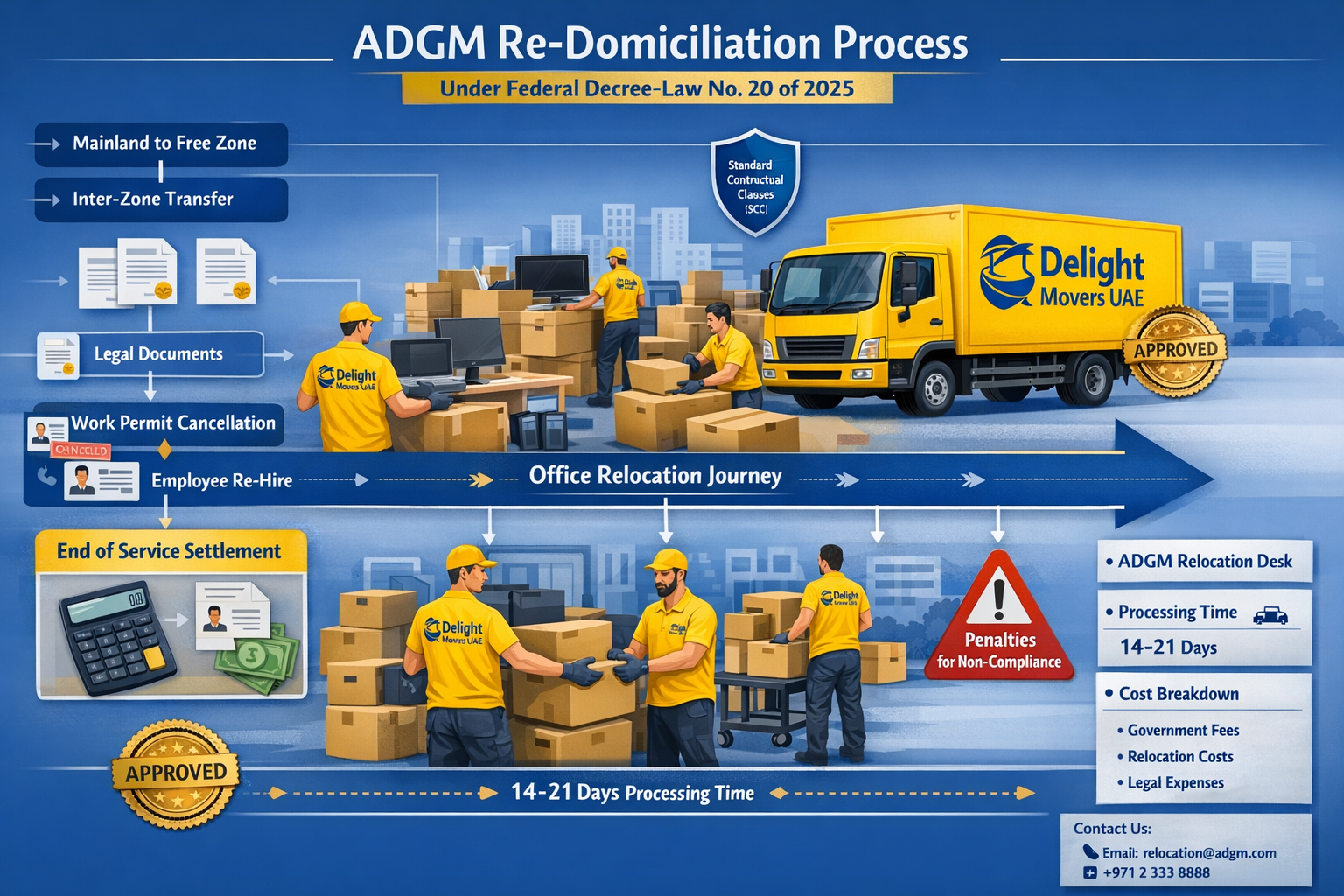
ADGM has actively embraced the re-domiciliation framework established under Federal Decree-Law No. 20 of 2025, creating streamlined procedures for companies relocating their legal seat to or from the zone[1].
The ADGM re-domiciliation process requires:
- Special resolution by shareholders (75% approval threshold)
- Board resolution authorizing relocation
- ADGM Registrar application submission
- Transferring jurisdiction NOC
- Solvency declaration by directors
- Creditor notification period (30 days)
- Final registration and certificate issuance
The complete timeline spans 14-21 business days for straightforward cases, extending to 30-45 days when creditor objections or regulatory queries arise[1].
ADGM’s implementing regulations provide detailed procedural requirements that were finalized in early 2026, offering greater clarity than initially available when the federal decree was first published. These regulations specify documentation formats, fee structures, and appeal procedures that create predictability for relocating businesses.
Contact ADGM relocation services at: Al Maryah Island, Abu Dhabi. Phone: +971 2 333 8888. Email: registration@adgm.com.
Employee Work Permit Transitions
ADGM operates its own employment visa system distinct from both UAE mainland and other free zones. Relocating employees to ADGM requires complete work permit cancellation with the previous employer and fresh applications through ADGM’s system[2].
The employee transition creates a critical compliance window. ADGM requires:
- Employment contract termination with previous entity
- Full settlement of end-of-service benefits
- Medical fitness certificate (valid within 60 days)
- Educational credential attestation
- Security clearance for certain roles
- New employment contract execution
The settlement obligation for end-of-service gratuities represents significant cash outlay. UAE labor law mandates 21 days of basic salary for each year of service (first five years) and 30 days for subsequent years. For a team of 20 employees with average tenure of three years, this settlement can easily exceed AED 200,000, dwarfing typical office movers cost[2].
Professional office movers coordinate physical relocation timing, but HR and legal teams must manage the employee transition timeline independently. Misalignment between these parallel processes creates operational gaps where businesses lack adequate staffing or employees work without valid authorization.
Cross-Zone Data Protection Compliance
ADGM maintains its own data protection regime modeled on GDPR, creating specific requirements for businesses relocating data infrastructure or employee records between jurisdictions[3].
Transfers between ADGM and UAE mainland require appropriate safeguards since mainland UAE is not on ADGM’s adequacy list. Standard Contractual Clauses provide the most common mechanism, though Binding Corporate Rules offer advantages for larger organizations with multiple entities[3].
Data protection relocation checklist:
- Data mapping exercise identifying all personal data locations
- Lawful basis assessment for continued processing
- Standard Contractual Clauses execution between entities
- Employee notification of data transfer
- Data Protection Impact Assessment for high-risk processing
- Technical security measures during physical data transfer
The data protection compliance process typically requires 2-4 weeks of legal preparation before office movers can relocate servers or backup storage. Businesses often underestimate this timeline, creating critical path delays in their overall relocation schedule.
For companies managing IT infrastructure relocation, our office relocation Abu Dhabi IT setup guide provides detailed protocols for minimizing downtime during server transitions.
Inter-Emirate Relocation Considerations
Moving office operations between Dubai and Abu Dhabi free zones creates unique logistical and regulatory challenges beyond single-emirate relocations.
The physical distance between Dubai’s free zones (DMCC, DIFC, JAFZA) and ADGM spans approximately 130-150 kilometers, requiring 90-120 minutes transportation time under normal traffic conditions. This distance impacts office movers cost through fuel surcharges, extended labor hours, and potential multi-day move requirements.
Inter-emirate relocation timeline:
- Day 1: NOC applications to both jurisdictions
- Days 2-10: Regulatory review and approval
- Days 11-12: Physical office relocation by professional movers
- Days 13-15: IT infrastructure setup and testing
- Days 16-20: Employee work permit processing
- Days 21-25: Final inspections and operational handover
The compressed timeline demands exceptional coordination between movers and packers, legal advisors, IT teams, and HR departments. Any single delay cascades through subsequent phases, potentially extending the total transition period by weeks.
Businesses planning Dubai-to-Abu Dhabi office moves should review our Dubai to Abu Dhabi office move guide for detailed route planning and compliance protocols.
Selecting Professional Office Movers for Free Zone Relocations
The complexity of free zone office relocation rules makes professional mover selection a critical success factor, not merely a commodity procurement decision.
Essential Qualifications and Experience
Professional office movers serving free zone clients must demonstrate specific capabilities beyond general furniture transportation:
Required qualifications:
- Valid trade license for moving and packing services
- Free zone access credentials and security clearances
- Commercial vehicle insurance (minimum AED 500,000 coverage)
- Professional indemnity insurance for high-value office equipment
- Documented experience with specific free zones
- IT equipment handling certifications
- Data security protocols and confidentiality agreements
The distinction between residential movers and specialized office movers becomes critical in free zone environments. Office relocation demands understanding of server room protocols, secure document handling, and coordinated timing that residential moves rarely require.
Verify your prospective movers and packers maintain current relationships with your target free zone’s facilities management. DMCC, DIFC, JAFZA, and ADGM each maintain approved vendor lists or preferred supplier programs that streamline access approvals and loading bay reservations.
Cost Transparency and Hidden Charges
Office movers cost should include comprehensive line-item breakdowns covering all relocation phases. Beware of artificially low quotes that exclude essential services:
Standard cost components:
- Pre-move survey and planning
- Packing materials and labor
- Furniture disassembly and reassembly
- Transportation and fuel
- Loading bay fees and parking permits
- Insurance coverage
- Unpacking and placement services
- Waste removal and disposal
Hidden charges often emerge around elevator reservations, after-hours access fees, and specialized equipment handling. Request detailed quotations that specify exactly what’s included and what triggers additional charges.
The most cost-effective office movers and packers aren’t necessarily the cheapest. Total cost of ownership includes downtime minimization, damage prevention, and compliance adherence. A AED 5,000 savings on movers cost becomes irrelevant if poor execution creates AED 50,000 in business disruption.
For comprehensive cost planning, our office movers cost analysis breaks down pricing factors across different office sizes and relocation scenarios.
Coordination with Free Zone Authorities
Experienced professional movers maintain direct relationships with free zone relocation desks, streamlining the coordination that inexperienced providers struggle to navigate.
Coordination checkpoints:
- Loading bay reservation confirmation
- Vehicle gate pass applications
- Security access credentials for moving crew
- Elevator booking and building access timing
- Parking permits for moving vehicles
- Waste disposal authorizations
- After-hours access approvals
DMCC’s Almas Tower, for example, requires 72-hour advance notice for loading bay reservations during business hours and 5-day notice for weekend access. Professional movers familiar with these requirements build appropriate buffers into project timelines.
DIFC’s Gate Building and other premium towers enforce strict security protocols including background checks for moving crew members and X-ray screening for all items entering the building. These protocols add 2-3 hours to move duration that inexperienced movers fail to account for.
The best office movers serve as project managers, coordinating not just furniture transportation but the entire ecosystem of stakeholders including building management, security teams, IT contractors, and regulatory authorities.
Insurance and Liability Considerations
Free zone office relocations often involve high-value IT equipment, confidential documents, and specialized furniture that demands comprehensive insurance coverage beyond standard moving policies.
Essential insurance coverage:
- Goods in transit insurance (minimum AED 500,000)
- Professional indemnity for data loss or confidentiality breaches
- Public liability (minimum AED 1,000,000)
- Workmen’s compensation for moving crew
- Storage insurance if temporary warehousing required
Review the insurance certificate directly from the provider’s insurance company, not just the mover’s summary. Verify coverage limits, exclusions, and claim procedures before signing relocation contracts.
High-value items like servers, specialized medical equipment, or trading floor technology may require supplemental coverage beyond standard policies. Declare these items explicitly and obtain written confirmation of coverage.
The insurance cost typically represents 2-3% of declared value for comprehensive coverage. For a AED 500,000 office fit-out and equipment value, expect AED 10,000-15,000 in insurance premiums. This expense protects against catastrophic loss that could exceed total office movers cost by orders of magnitude.
Minimizing Downtime During Free Zone Office Relocation
Business continuity during office relocation separates successful transitions from disruptive failures. Strategic planning minimizes revenue loss and maintains client service levels throughout the move.
Phased Relocation Strategies
Large offices benefit from phased approaches that relocate departments sequentially rather than simultaneous full-office moves:
Phased relocation timeline:
- Week 1: Back-office functions (HR, finance, admin)
- Week 2: IT infrastructure and server room
- Week 3: Sales and client-facing teams
- Week 4: Executive offices and meeting facilities
This approach maintains operational capacity throughout the transition. Client-facing teams continue working from the original location while support functions establish operations in the new space.
The phased strategy increases total office movers cost by 15-25% due to multiple mobilizations, but the business continuity value often justifies this premium. A consulting firm generating AED 200,000 weekly revenue cannot afford complete shutdown; the incremental moving cost pales compared to lost billings.
After-Hours and Weekend Moves
Free zones typically permit after-hours access for office relocation, creating opportunities for zero-downtime transitions:
After-hours advantages:
- No business disruption during working hours
- Reduced elevator competition in multi-tenant buildings
- Faster loading bay access without daytime congestion
- Lower traffic volumes for inter-zone transportation
- Immediate Monday morning operational readiness
Professional movers charge premium rates for after-hours service, typically 30-50% above standard pricing. A AED 20,000 weekday move becomes AED 26,000-30,000 for weekend execution.
The premium proves worthwhile for businesses where downtime costs exceed the incremental moving expense. A trading firm or customer service operation with 24/7 commitments cannot afford business-hours disruption.
DMCC, DIFC, and ADGM all accommodate weekend relocations with appropriate advance notice. JAFZA’s industrial nature makes after-hours access particularly straightforward compared to premium office towers.
For detailed after-hours coordination strategies, our office relocation Dubai night moves guide provides comprehensive protocols for zero-downtime transitions.
IT Infrastructure Transition Planning
Technology infrastructure represents the most complex and risk-prone element of office relocation. Server downtime, data loss, or connectivity failures create business impact far exceeding typical office movers cost.
IT relocation checklist:
- Complete data backup 48 hours before move
- Network topology documentation
- Cable labeling and photography
- Server shutdown procedures and sequencing
- Transportation climate control for sensitive equipment
- Rapid deployment plan for new location
- Connectivity testing protocols
- Rollback procedures if issues arise
Engage specialized IT movers for server rooms and data centers. General office movers and packers lack the technical expertise for enterprise-grade IT infrastructure. The specialized service costs 40-60% more than standard furniture moving but prevents catastrophic failures.
Cloud-based operations enjoy significant advantages during office relocation. Businesses running on Microsoft 365, AWS, or similar platforms maintain full operational capacity regardless of physical office location. The transition becomes primarily about workstations and meeting spaces rather than critical infrastructure.
Plan IT cutover for Friday evening with full weekend available for troubleshooting. Monday morning operational readiness becomes achievable even when unexpected issues arise.
Employee Communication and Change Management
The human dimension of office relocation often receives insufficient attention compared to logistics and compliance. Clear communication prevents productivity loss and maintains morale during transition periods.
Communication timeline:
- 8 weeks before: Initial announcement with rationale and benefits
- 6 weeks before: Detailed FAQ addressing common concerns
- 4 weeks before: Individual desk assignments and floor plans
- 2 weeks before: Packing instructions and personal item guidelines
- 1 week before: Final logistics and first-day procedures
- Move day: Real-time updates and support contacts
- Week after: Feedback collection and issue resolution
Assign relocation champions within each department who serve as information conduits and address team-specific concerns. These champions coordinate with professional movers regarding department-specific requirements.
Provide packing supplies and clear guidance on personal item handling. Employees uncertain about what to pack themselves versus what movers and packers will handle create last-minute confusion that delays the entire move.
The change management investment pays dividends through maintained productivity and reduced post-move adjustment period. Businesses that neglect this dimension experience 2-3 week productivity dips that cost far more than the communication effort required.
Common Compliance Pitfalls and How to Avoid Them
Even experienced business leaders make critical errors during free zone office relocation that trigger penalties, delays, and unnecessary expenses.
Premature Lease Commitments
Signing new office leases before obtaining NOC approval from current and receiving free zones creates financial exposure when approvals face unexpected delays or denials.
The proper sequence:
- Identify target office space and negotiate terms
- Submit NOC applications to both jurisdictions
- Obtain written approvals
- Execute lease agreement
- Coordinate with office movers for physical relocation
Reversing steps 2 and 4 creates liability for rent on space you cannot legally occupy. Free zone authorities occasionally deny relocation requests due to outstanding compliance issues, pending litigation, or incomplete documentation.
Negotiate lease agreements with conditional clauses that permit termination if regulatory approvals aren’t obtained within specified timeframes. Landlords in competitive markets often accommodate these provisions to secure tenants.
Inadequate Employee Settlement Budgeting
The mandatory settlement of end-of-service benefits before work permit cancellation catches many businesses unprepared. This obligation exists regardless of whether employees continue with the company in the new jurisdiction[2].
Calculate total settlement liability early in planning:
Settlement calculation example:
- 15 employees with average 3-year tenure
- Average monthly salary: AED 8,000
- Settlement rate: 21 days per year for first 5 years
- Total liability: 15 employees × AED 8,000 × (21/30) × 3 years = AED 252,000
This AED 252,000 cash requirement dwarfs typical office movers cost and creates cash flow pressure if not anticipated. Budget this expense separately from relocation logistics.
Some businesses attempt to avoid settlement by having employees resign and immediately re-join, but this strategy violates labor law and creates enforcement risk. Authorities increasingly scrutinize such arrangements, particularly in financial free zones with heightened regulatory oversight.
Data Protection Oversights
Businesses relocating between jurisdictions with different data protection regimes often overlook mandatory compliance steps, creating regulatory exposure and potential fines[3].
Common oversights include:
- Failing to execute Standard Contractual Clauses before data transfer
- Not conducting Data Protection Impact Assessments for high-risk processing
- Inadequate employee notification of data transfer
- Lack of technical security measures during physical server relocation
- Missing data processor agreements with office movers handling confidential documents
DIFC and ADGM impose substantial penalties for data protection violations, ranging from AED 50,000 to AED 500,000 depending on severity. These fines exceed total office relocation costs for most small and medium businesses.
Engage data protection counsel at the planning stage, not after movers and packers have already transported servers. The legal review typically requires 2-4 weeks and costs AED 8,000-15,000, but prevents violations that carry multiples of this expense in penalties.
Insufficient Loading Bay Coordination
Premium office towers in DMCC and DIFC maintain strict loading bay reservation systems that inexperienced movers fail to navigate effectively. Missing your reserved slot creates cascading delays.
Loading bay best practices:
- Book 5-7 days in advance for business hours access
- Confirm reservation in writing 48 hours before move
- Arrive during first 30 minutes of reserved window
- Have all required documentation immediately available
- Maintain direct contact with building management throughout move
- Build 2-hour buffer into timeline for unexpected delays
DIFC’s Gate Building limits loading bay access to 2-hour windows, strictly enforced. Overrunning your slot triggers rescheduling that can delay your entire move by days during peak periods.
Professional office movers maintain relationships with building management that provide flexibility when issues arise. This relationship value justifies premium pricing over discount movers lacking these connections.
For businesses relocating within Dubai’s premium commercial districts, our movers in Downtown Dubai guide addresses building-specific protocols and coordination strategies.
Frequently Asked Questions
How long does the NOC process take for free zone office relocation?
NOC processing timelines vary by free zone. DMCC and JAFZA typically process applications within 5-7 business days for intra-zone moves, while DIFC requires 7-10 days and ADGM needs 14-21 days. Inter-zone relocations or mainland transitions add 5-7 days to these baselines. Submit applications at least three weeks before your intended move date to accommodate potential delays or documentation requests.
Can I relocate employees from mainland to free zone without terminating their employment?
No. UAE regulations require complete work permit cancellation with MoHRE and fresh applications through the Free Zone Authority. This creates a technical employment termination even when the individual continues with the same company. You must settle all end-of-service benefits, accrued vacation, and outstanding salaries before canceling mainland permits. The process typically takes 7-14 days and represents significant cash outlay beyond office movers cost.
What happens if I operate from a new office before obtaining NOC approval?
Operating from unauthorized locations triggers immediate penalties. DMCC imposes AED 5,000 initial fines, escalating to AED 10,000 after 30 days and potential license suspension after 60 days. DIFC and ADGM enforce similar penalty structures with additional regulatory reporting obligations for licensed financial services firms. These penalties far exceed typical professional movers costs and create reputational damage through public enforcement actions.
Do I need separate data protection compliance for office relocation?
Yes, if relocating between jurisdictions with different data protection regimes. DIFC and ADGM maintain GDPR-equivalent frameworks that require Standard Contractual Clauses or Binding Corporate Rules for data transfers to UAE mainland. Conduct Data Protection Impact Assessments for high-risk processing and execute appropriate safeguards before office movers relocate servers or employee records. Legal review typically costs AED 8,000-15,000 but prevents penalties ranging from AED 50,000 to AED 500,000.
How much should I budget for total office relocation costs including compliance?
Total costs extend well beyond movers and packers charges. For a typical 25-person office, budget: office movers cost (AED 12,000-20,000), NOC fees (AED 1,000-2,000), new lease registration (AED 2,000-4,000), employee settlement benefits (AED 150,000-300,000 depending on tenure), legal and compliance review (AED 10,000-20,000), IT infrastructure setup (AED 15,000-30,000), and contingency buffer (10-15% of total). Total budget: AED 190,000-376,000 for comprehensive relocation.
What’s the difference between flexi-desk and dedicated office for free zone compliance?
Flexi-desk arrangements provide shared workspace access with limited visa allocations, suitable for small teams. DMCC permits up to six visas on flexi-desk licenses, while JAFZA allows similar flexibility. Dedicated offices provide exclusive space with higher visa quotas based on square footage. DIFC requires dedicated office space for visa issuance, making flexi-desk options unavailable for companies needing employee visas. Your choice impacts both office movers cost and ongoing occupancy expenses.
Can professional movers handle IT equipment and servers?
General office movers and packers can transport basic IT equipment like workstations and printers. However, server rooms and enterprise-grade infrastructure require specialized IT movers with climate-controlled transportation, anti-static packaging, and technical expertise. Specialized IT relocation costs 40-60% more than standard furniture moving but prevents data loss and equipment damage. For mission-critical systems, engage dedicated IT movers rather than general relocation providers.
How do I minimize business downtime during office relocation?
Implement phased relocation strategies that move departments sequentially, maintaining partial operations throughout transition. Schedule physical moves for weekends or after-hours to preserve business-day productivity. Prioritize cloud-based systems that maintain functionality regardless of physical location. Plan IT cutover for Friday evening with full weekend for troubleshooting. Budget for after-hours moving premiums (30-50% above standard rates) when downtime costs exceed the incremental expense. Comprehensive planning typically reduces downtime from 3-5 days to zero for well-executed transitions.
Conclusion
Free zone office relocation in 2026 demands far more than selecting capable movers and packers. The regulatory framework established under Federal Decree-Law No. 20 of 2025 creates both opportunities and compliance obligations that business leaders must navigate with precision.
Successful office relocation requires coordinating multiple parallel workstreams: NOC applications and regulatory approvals, employee work permit transitions and benefit settlements, data protection compliance reviews, physical logistics coordination with professional movers, and IT infrastructure migration. Each workstream operates on distinct timelines that must align for seamless transition.
The total cost extends well beyond office movers cost to encompass legal fees, employee settlements, regulatory charges, and potential business disruption. A comprehensive budget for 25-person office relocation typically ranges from AED 190,000 to AED 376,000, with employee settlement benefits often representing the largest single expense.
DMCC, DIFC, JAFZA, and ADGM each maintain distinct procedures, timelines, and requirements. Success demands zone-specific expertise rather than generic relocation knowledge. Engage professional office movers with demonstrated experience in your specific free zone and maintain direct communication with zone relocation desks throughout the process.
The penalties for non-compliance far exceed the cost of proper execution. License suspensions, work permit violations, and data protection breaches create business disruption and reputational damage that dwarf any savings from cutting corners on compliance or professional services.
Next Steps for Your Office Relocation:
- Contact your target free zone’s relocation desk to understand specific requirements
- Calculate total employee settlement liability and secure necessary funding
- Engage data protection counsel if relocating between different regulatory regimes
- Request detailed quotations from experienced office movers with free zone expertise
- Develop comprehensive project timeline with 3-week buffer before target move date
- Schedule pre-move survey with professional movers to identify potential issues
- Initiate NOC applications at least 21 days before intended relocation
For businesses seeking trusted UAE movers with deep free zone expertise, professional packing services, and a track record of seamless moving experiences, partnering with specialists who understand both regulatory compliance and logistics execution creates the foundation for stress-free relocation and hassle-free transition to your new workspace.
The complexity of free zone office relocation rules makes expert guidance invaluable. Whether you’re moving within DMCC, transitioning to DIFC, relocating to JAFZA, or establishing operations in ADGM, comprehensive planning and experienced execution partners transform a potentially disruptive process into a delightful moving journey that positions your business for continued success.
References
[1] Re Domiciliation In The Uae – https://ms-ca.com/news-and-blogs/re-domiciliation-in-the-uae
[2] Mainland To Free Zone Transition In The United Arab Emirates 896 – https://lawzana.com/articles/united-arab-emirates/mainland-to-free-zone-transition-in-the-united-arab-emirates-896
[3] Cross Border Data Transfers Under Uae Law In 2026 – https://www.kayrouzandassociates.com/insights/cross-border-data-transfers-under-uae-law-in-2026
[4] Free Zone Vs Mainland Hiring Rules Uae – https://www.remotepass.com/blog/free-zone-vs-mainland-hiring-rules-uae
[5] Uae Business Setup In 2026 Whats Changing For Free Zone And Mainland Companies – https://elevateauditing.com/uae-business-setup-in-2026-whats-changing-for-free-zone-and-mainland-companies/


